If your client/browser supports it, you may prefer the
original Markdown version of this article.
Dispatches from Transylvania (I) : first impressions
It's probably fair to say that Transylvania isn't a common holiday destination for British people. It doesn't have the sunny, golden beaches of Spain -- in fact, it has no sea borders at all. It doesn't have the striking cultural attractions of Greece and Italy, unless you count Bran Castle, which plays up its tenuous Dracula connections with quiet desperation.
What it does offer, though, is outstanding mountain walking, and a chance to see the last vestiges of a rural way of life that's continued unchanged for centuries but which now, for better or worse, is in terminal decline. Transylvania also offers a chance of being eaten by a bear, an unusual fate in London.
Transylvania isn't particularly difficult to get to. There are regular flights from London to Bucharest, and a couple of hours on the train gets you to Brașov, a bustling medieval town at the foot of the Carpathian Mountains. Brașov displays its name on the mountaintop, like Hollywood; you're not going to forget where you are.
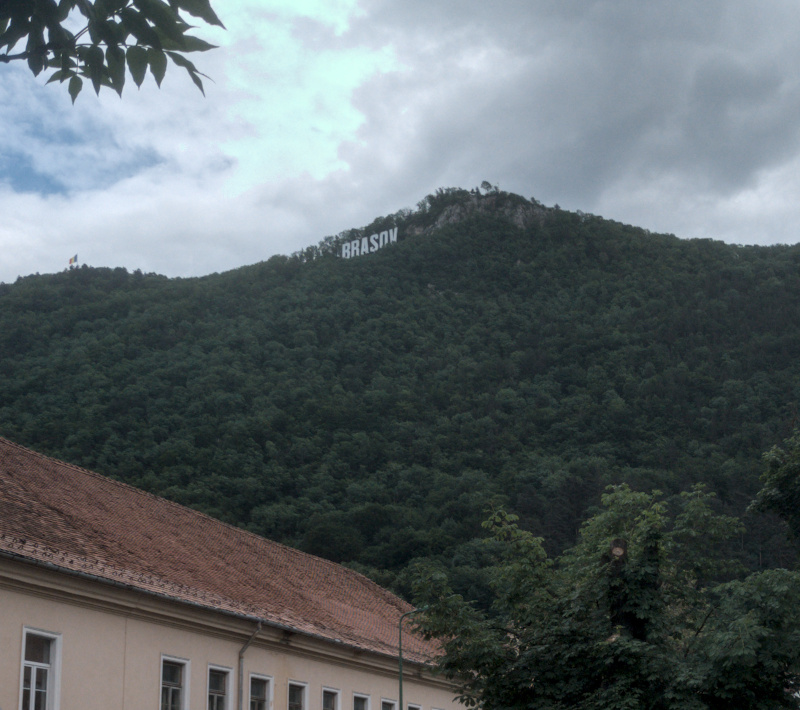
If visiting Brașov is like a trip back to the middle ages, it's one that pops in around 1975 on the way. I'd forgotten what it's like to walk around a place where everybody smokes cigarettes. It isn't just here: I discovered that smoking is far more widespread in Romania that it is in the UK; but no other town rivalled Brașov for its nicotine fug. Some of the social attitudes, I will eventually discover, are distinctly 1970s as well.
If your image of Transylvania comes primarily from 1970s movies starring Christopher Lee and Boris Karlov, you might be surprised to learn that the region as a whole is not mountainous. The Carpathians surround a vast, elevated, fertile plain. Transylvania, after all, means across the forest, not on top of it. You can stand in the middle of the Transylvania plateau and see nothing but flat farmland and pasture in all directions. There isn't a constant lightning storm, either: except on the mountain tops, the weather is much the same as that of the UK, with few meteorological extremes. The mountain peaks are different, of course: they're snow-covered all year round, and they generate their own climate.
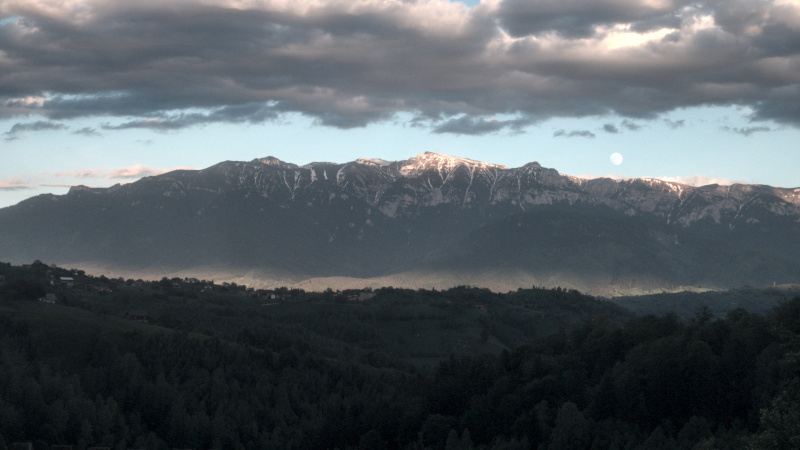
From Brașov, an hour or two on the bus will get you well into the mountains. Eventually you'll be travelling on roads that are barely surfaced, and where cattle are more common that cars. You'll still see horse-draw wagons but, this being the 21st century, there are some concessions to modernity.
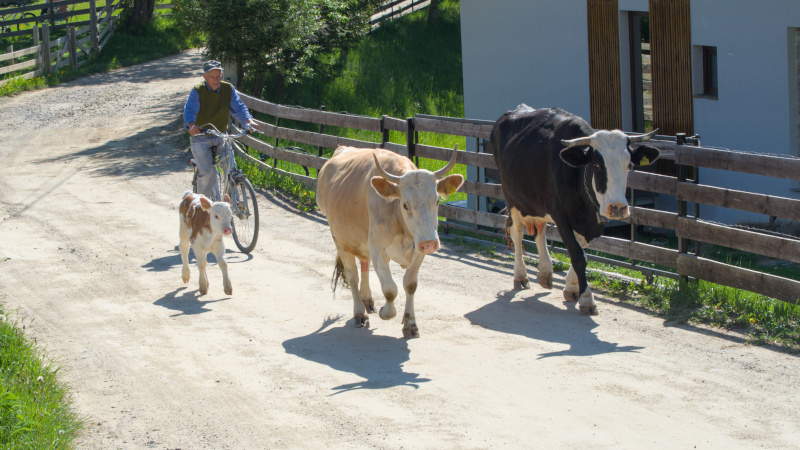
This is what I think of as the "real" Transylvania -- the part where you expect to see a crumbling, haunted castle around every corner. In fact, there are few such buildings; quite a few of the buildings I do see lie in disrepair.
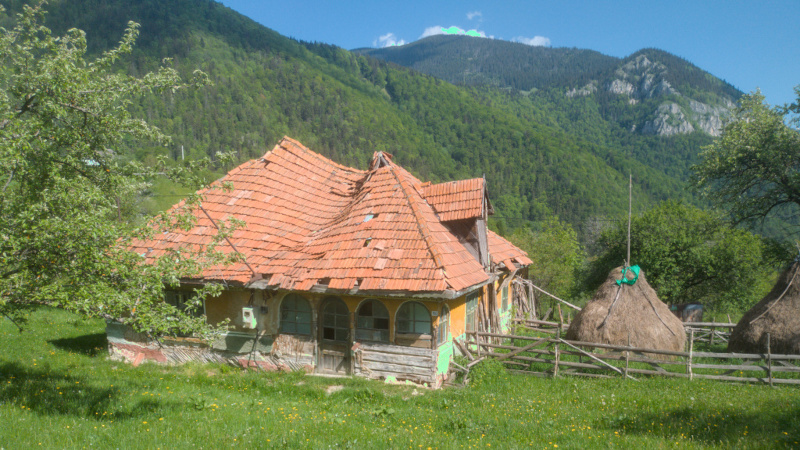
The house in the photo isn't a 19th-century crofter's cottage: it is -- or was -- a modern, comfortable dwelling with mains electricity and broadband Internet access. It's been abandoned relatively recently -- as can be seen from the more-or-less intact haystacks.
The mountain roads reveal lots of buildings like this, and it's no great surprise. After all, why would you eke out a subsistence living cutting hay with sickles, and driving cattle with a stick the way you grandfather did, when you could make the short trip to Cluj-Napoca and get a well-paid job in the IT industry?
There are still people -- many people -- farming in the Carpathians in more-or-less the traditional way. They still clear the forests for pasture and hay meadows, which they still cut with sickles. They still drive enormous herds of sheep and cattle from one place to another, still accompanied by packs of enormous, ferocious dogs (because... bears). But there are fewer and fewer such people, and the forests are starting to reclaim the meadows.
You can't help noticing the dogs in the Carpathians: they're everywhere. Not just the working dogs, but feral animals that, presumably, were once somebody's pet. They trot up and down the streets, begging food from tourists. They know better than to pester the local people, who throw things at them.
Still, I'm told that the large number of feral dogs in a positive sign. There were no wandering dogs during the communist era, after all: people were forced to eat them. These days, the main threat to Transylvania's feral dog population isn't hungry Soviet citizens, but wolves. If wolves and dogs are relatives, the wolves certainly don't respect the family connection.
The Carpathians caught me off-guard at almost every turn. I saw a group of Orthodox monks, robed and with waist-length beards, driving around in a four-wheel-drive truck and looking for all the world like a 1980s rock band. The public parks have rubbish bins enclosed in huge, steel cages, which I discovered were to keep the bears out. Yes, it's not just Yogi that goes after pic-a-nic baskets.
This isn't the only place where I've seen storks' nests on the tops of chimneys, but some I saw in the Carpathians where the size of hay bales. There are mountain roads with loose surfaces, peppered with switch-backs overlooking sheer drops of hundreds of meters. The first time I was driven up such a road it was dark, so I didn't realize how terrifying it was. The next day I saw, though, and my knees went weak at the sight.
It saddens me that traditional Transylvanian rustic life might end in my lifetime, leaving a whole culture to be swallowed up by trees. Of course, it won't be the first time in human history that such a thing has happened.
Published 2026-06-03, updated 2026-06-03
Categories
gemlogConverted from my Gemini capsule.