If your client/browser supports it, you may prefer the
original Markdown version of this article.
Dispatches from Transylvania (III) : Bran Castle
It's probably fair to say that tourists don't visit Transylvania for a Disneyland experience. They come, as I did, for the mountains, the hiking, and the wildlife. As far as I know, Bran Castle is the closest thing that Transylvania has to a tourist attraction, and it's insanely popular. On the day I visited -- a rainy Tuesday in May -- visitors were struggling along its narrow corridors shoulder-to-shoulder and that, I was told, was a quiet day.
"What's it like on a busy day?" I asked one of the guides.
"Better you don't find out," she replied, shuddering.
From an archaeological or sociological perspective, there are hundreds of castles in the UK that are more interesting than Bran. They tend to be more accurately described than Bran, with histories backed up by painstaking academic research. Many contain displays of authentic artefacts that were in use when the castle was actually a fortification.
But no UK castle boasts a real-life vampire as a one-time resident.
And "boast" is exactly what Bran does. Its top floor is given over completely to tawdry folkloric displays, including a room containing a coffin surrounded by candles -- and not even real candles because, presumably, that would be a fire hazard. The rooms in this part of the castle are dark, with graveyard scenes and monsters projected onto the walls. There's even a "torture chamber" exhibit, which even the castle guides warned me not to waste my money on. Apparently, nothing on display there is actually from the Castle at all. In fact, little in Bran Castle today is historically authentic.
Today's historians doubt that Vlad "The Impaler" Țepeș -- the prototype for the fictional Count Dracula -- spent any time in Bran Castle. But there's no doubt in Bran Castle itself. Vlad's place in the lineage of its occupiers is proudly displayed on the castle timeline near the tourist entrance. Bran plays up its Vlad connection desperately, at every opportunity. There's even a room containing a waxwork dummy of the man, surrounded by heads on spikes. "Parental guidance is advised", apparently, but it's about as scary as Scooby Doo.
Leaving aside the dubious Vlad connection, and the terrible overcrowding, Bran is actually a delightful architectural edifice. It's full of twisty corridors and widow-maker staircases, with charming upper-storey covered balconies that look down over the inner courtyard. Situated on a mountain pass between Wallachia and Transylvania, the castle's towers offer splendid views of the mist-shrouded Carpathians.
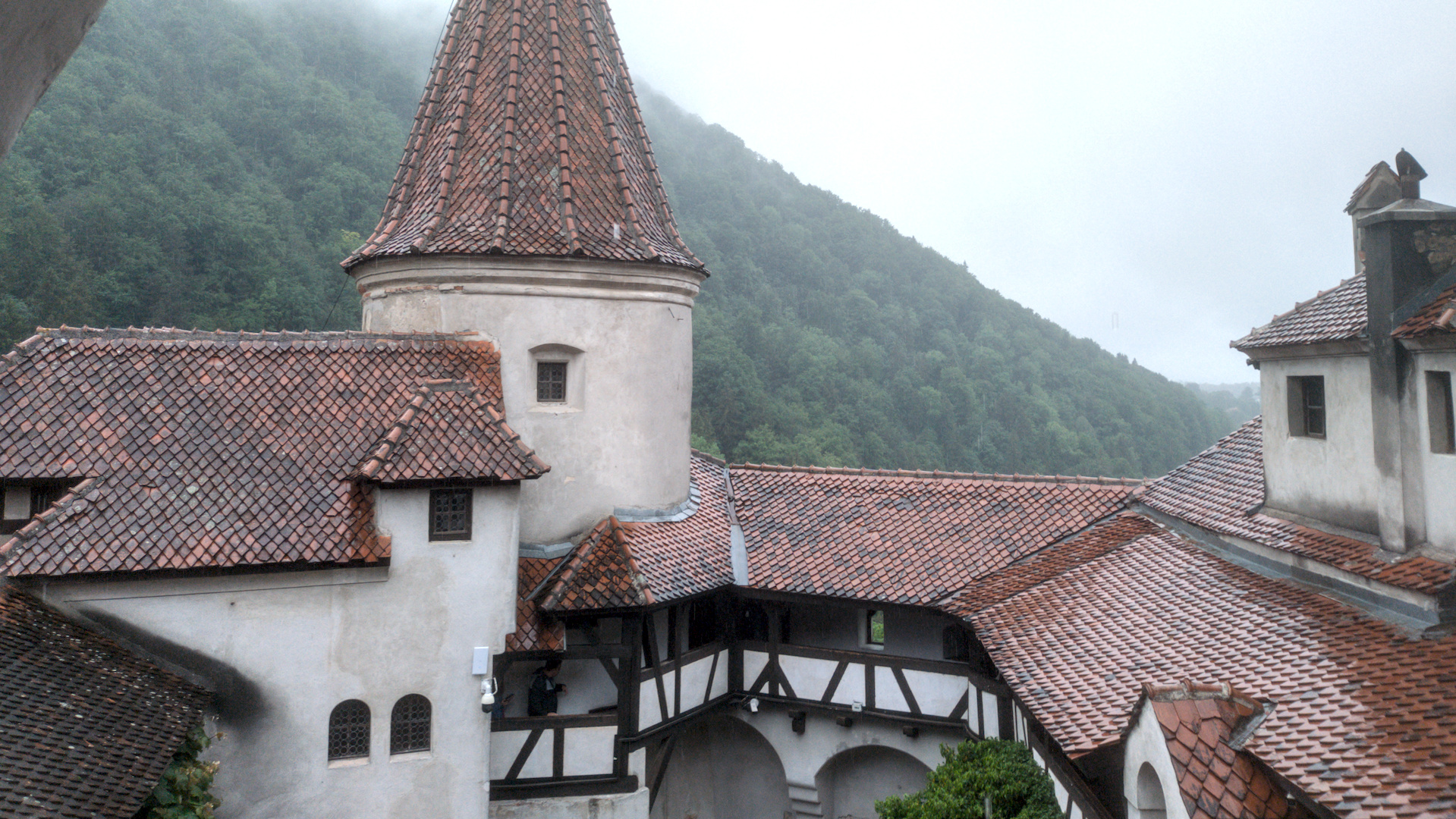
What do we know of the real history of Bran Castle? Not all that much, it turns out. There's probably been a fortification on the site since the 11th century, but the castle really only came to prominence as a customs post on the border between Transylvania and Wallachia in the 14th century. Thereafter it changed hands repeatedly -- the various regions of Romania seem to form political allegiances that last as long as a cup of coffee.
The ownership of Bran Castle remains somewhat unclear, even after a number of protracted legal cases in several countries. The fabric of the building is probably the property of the royal family of Romania, but the rights to operate it as a tourist attraction appear to belong primarily to the US-based Ad Populum group, which runs a number of other heritage sites. When the royal family took control of the castle after World War II, they found it stripped bare. This probably explains why none of the castle's contents are original.
In the castle precincts are many small shops and stalls selling -- you guessed it -- vampire tat. My favourite among the many bizarre and groan-inducing knick-knacks was a Dracula oven mitt. What makes this product so magnificently absurd is that the famous blood-sucker had, presumably, little need for kitchenware. There was also a Dracula knuckle-duster, which I would have bought, had I been certain of not being searched at customs on the way home.
So what are we to make of Bran castle? On the one hand it's a tawdry, vulgar display of touristic excess. Nothing reliable can be learned in it about the history of the castle, or the region in which it stands. The folks who run it could take a lesson from the UK's National Trust in how to run a heritage site as a tourist attraction in an interesting and respectful way.
On the other hand, despite the crowds and the vampire tat, Bran Castle is a fascinating building, set in an area of breathtaking natural splendour. Even the vampire stuff is so over the top that it's amusing, rather than offensive.
I don't think I'll be visiting Bran Castle again, but I don't regret that I did.
Published 2026-06-19, updated 2026-06-19
Categories
gemlogConverted from my Gemini capsule.